30 Home: a Facebook ad that refuses to shame
Service:
Copywriting
One ad for people who felt punished by every fitness program, plus the KPI plan, four-week test roadmap and targeting spec a media buyer would ask for.
Download: CopyWireframe PDFCase study
Speculative work. 30 Home is a fictional 30-day fitness reset created for this portfolio piece.
Have a brief like this? Book a 30-minute call or email it.
The brief
Create emotionally resonant Facebook ad copy targeting individuals with above‑average BMI who have attempted fitness programs in the past and felt punished rather than supported. The goal is to reframe fitness as an act of self-love, not self-hate.
Individuals who have struggled with weight loss, felt discouraged by discipline‑based fitness programs, and are open to trying a gentler, self‑respecting approach.
The copy
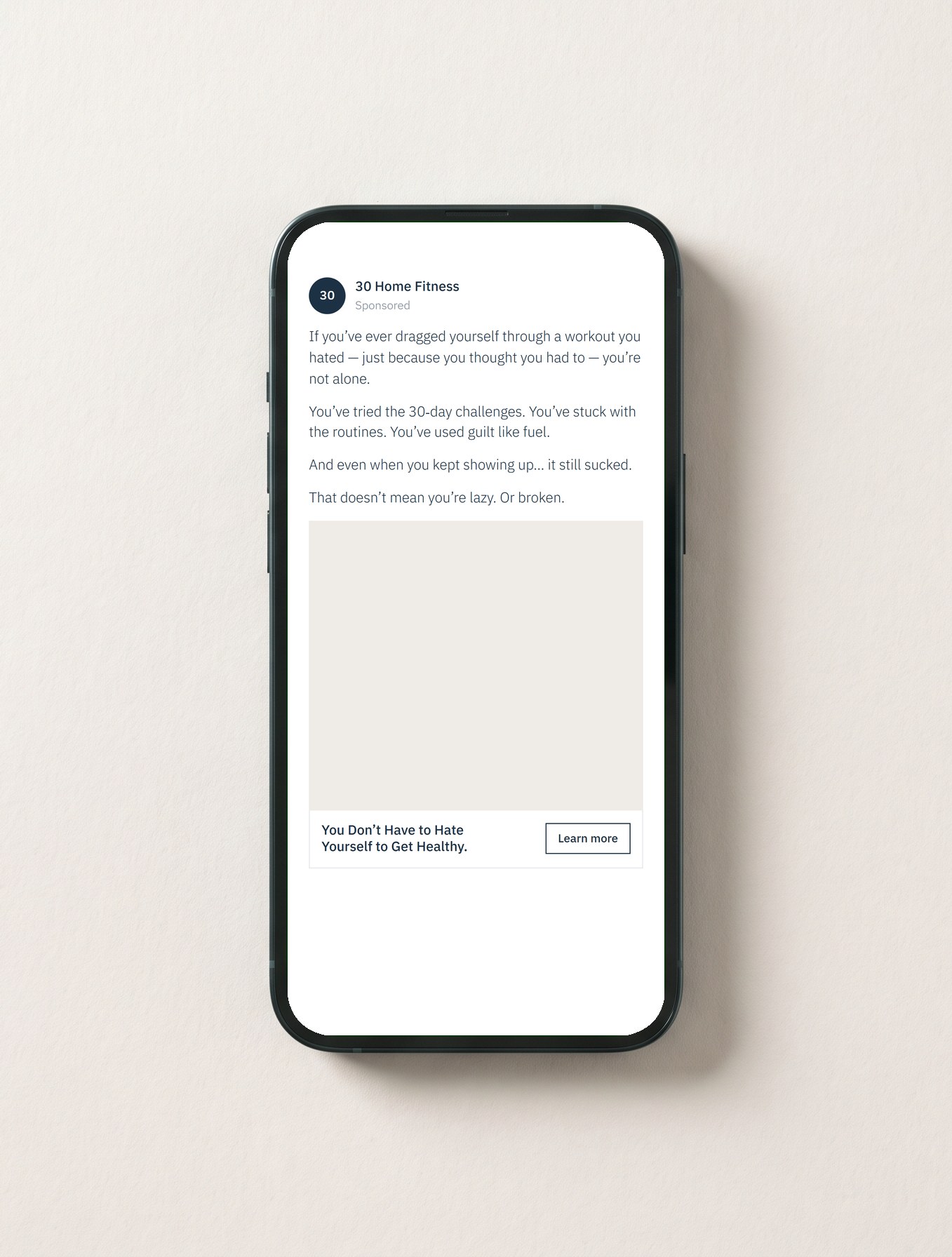
30 HomeSponsored
If you’ve ever dragged yourself through a workout you hated — just because you thought you had to — you’re not alone.
You’ve tried the 30‑day challenges. You’ve stuck with the routines. You’ve used guilt like fuel.
And even when you kept showing up… it still sucked.
That doesn’t mean you’re lazy. Or broken.
It just means you’ve been taught the wrong way to care for yourself.
We always say we hate working out. But maybe it’s not the workout.
Maybe we hate how we feel walking into them — already beating ourselves up, rushing through it, doing it out of punishment.
And if that’s what we bring in, of course it feels miserable.
Maybe we don’t need a harder program.
Maybe we just need a softer way in.
That’s why I created 30 Home.
It’s a 30‑day reset — not to become someone else, but to come back to yourself.
No shame. No forcing. No guilt‑driven grind.
Just gentle, doable movement — grounded in one belief:
You don’t have to fix yourself to feel good.
You can lose weight and treat yourself with love.
One day at a time. One kind choice at a time.
You’ve worked hard.
Now try home.
You Don’t Have to Hate Yourself to Get Healthy.
The wireframe
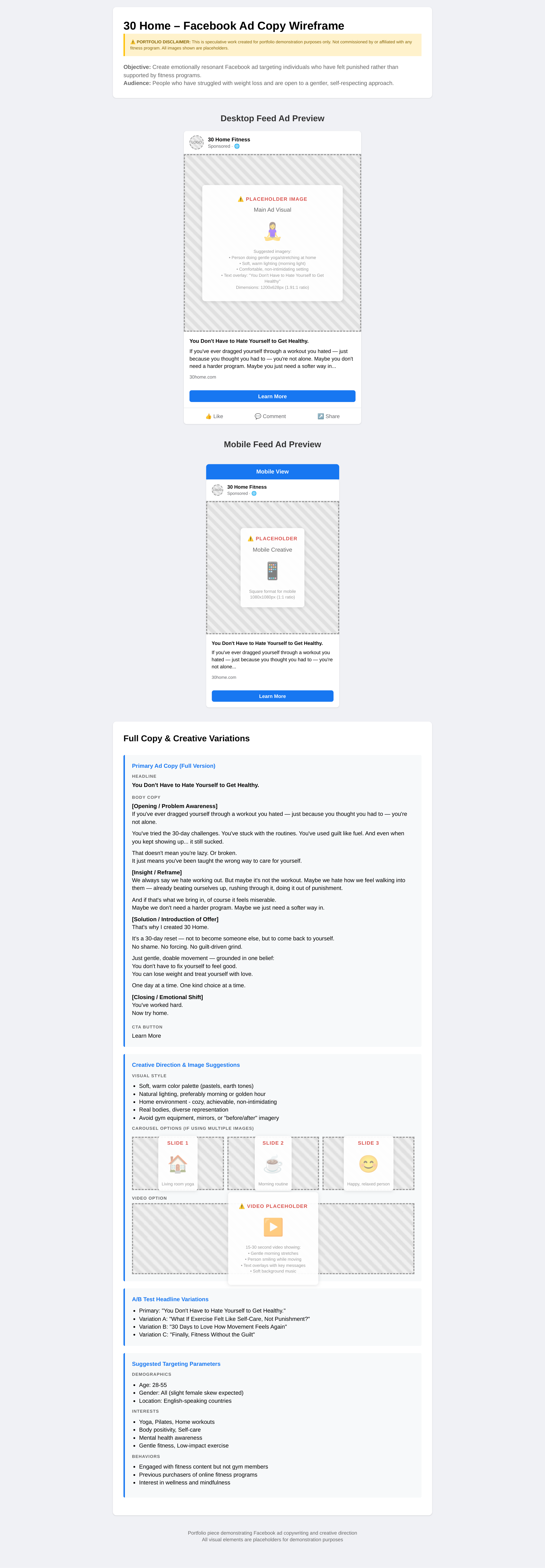
You don't have to hate yourself to get healthy: the case study
You Don’t Have to Hate Yourself to Get Healthy: A Compassionate Facebook Ad Case Study
Who this is for: brand leaders, email and paid social managers, and copywriters who want to learn how empathy and evidence work together in performance creative.
When fitness marketing leans on shame, it converts short term and burns people out. That is familiar. The other thing that is true and less noticed is this. When we treat people with decency, their guard drops. They listen. They test. They stay. Over time, that human-first approach pays better than fear based tactics.
This is a case study of a speculative Facebook ad for 30 Home, a 30 day fitness reset designed for people with above average BMI who have tried discipline based programs and felt punished, not supported. The ad reframes fitness as an act of self respect. It is a small piece of work with a big idea. It also proves a larger point. Being skilled and being human are not separate strategies. They are the same one.
Project overview Objective
Create emotionally resonant Facebook creative that stops the scroll and speaks to people who have tried and quit harsh programs. The immediate goal is sign ups for a low friction 30 day reset. The long term goal is trust and retention.
Audience
Adults who have tried fitness programs before, felt shame or failure, and are open to a gentler approach. They want change but not at the cost of self respect.
Role
Copywriter and strategist, speculative creative, testing plan and measurement framework included.
Key principles applied
IVOC, anti gatekeeper voice, reframe instead of blame, falsifiable claims, social proof, nurture, and low friction offers.
Rule of One reminder
One reader: a hesitant person who wants change but fears punishment. One idea: fitness can be kind and effective. One offer: 30 Home, a gentle 30 day reset. One action: sign up or learn more.
The creative: headline and primary ad Headline You Don’t Have to Hate Yourself to Get Healthy
This headline is permission in three words. It removes the premise of punishment and replaces it with dignity.
Ad body copy breakdown Opening, aka meet the reader where they are
If you have dragged yourself through a workout you hated just because you thought you had to, you are not alone. You tried the 30 day challenges. You used guilt like fuel. It still sucked.
This opening acknowledges effort without amplifying shame. It validates work and frames past attempts as experience, not failure.
Insight and reframe
Maybe it is not the workout. Maybe it is how you walk into them, already beating yourself up, doing it out of punishment. That is the pivot. It suggests a new explanation and a different choice.
Solution introduction
That is why we created 30 Home. A 30 day reset not to become someone else but to come back to yourself. No shame. No forcing. Just gentle movement and daily, doable choices.
Close and emotional shift
You have worked hard. Now try home.
This close is an invitation, not a demand.
Variants we would test Short single line for video overlay
You do not have to hate yourself to get healthy.
Long form primary text for news feed
If workouts felt like punishment, you were doing it wrong. This 30 day reset is gentle, doable, and built for people who want to feel better, not smaller. Join a program that starts with respect.
Carousel frame ideas
Frame 1: I tried the hard programs and failed.
Frame 2: I tried being kind to myself and stuck with it.
Frame 3: This is how it actually worked.
Call to action tests
● Join the reset
● Start the gentle plan
● Learn how home can work for you
Each variant answers different objections and measures which voice performs best.
Landing page and funnel notes
The ad must point to a lightweight landing page that reduces perceived risk. Key elements:
Hero
Headline that echoes the ad and a short subhead that promises a simple next step.
Micro social proof
Short quotes from people who felt the same way, ideally with first names and simple metrics like number of days completed or small wins described.
Mechanics and commitments
Explain what a day looks like. No heavy language. One movement per day, 10 to 20 minutes, tracking options.
Risk reversal
Money back guarantee or a low cost trial week. Make the pilot obvious and predictable.
Nurture path
If someone signs up for the lead magnet or trial, enroll them into a gentle email sequence that reinforces the reframe and reduces churn.
What we would measure and how Primary KPIs
● Click through rate on the ad to landing page.
● Cost per lead or trial sign up.
● Conversion rate from trial to paid program.
● Retention at 7 and 30 days.
Secondary signals
● Ad comments sentiment.
● Time on landing page and scroll depth.
● Email open and reply rates. These measure trust and engagement.
A simple pilot with a small budget over two weeks gives us early evidence. If the CTR is above benchmark and the CPA is acceptable, we scale and refine the creative. If not, we iterate the angle based on comments and heatmap data.
Ethical guardrails
This creative intentionally avoids shame language, quick fix claims, or anything that suggests the person is broken. We also avoid calling out metrics for body size that feel judgemental.
Marketing with empathy is not soft messaging. It is careful messaging. We state outcomes we can reasonably influence and avoid promises we cannot prove.
Falsifiability matters. If we claim improved consistency, we measure it. If we claim weight loss we provide a reasonable timeframe and examples under similar conditions.
The OCPB moment Objection
I have tried this before and nothing changed.
Claim
This is different because it starts with respect and builds sustainable habits.
Proof
Pilot plan and social proof, plus a transparent week by week outline we can test. We do A B on the reframe vs the push tactic and measure retention.
Benefit
Less shame, more sustainable progress, a program people will actually finish.
When the claim is beside live evidence, the benefit becomes believable.
Why kindness is proof
We have argued in earlier pieces that clients and customers choose based on proof. Proof includes numbers and also patterns of behavior. When a brand speaks with the same decency you would use with a friend, you remove friction. That removal is measurable. Lower friction means higher conversion. Higher retention means lower acquisition cost over time.
Kindness in copy is not a soft metric. It is a conversion lever. People who feel respected are more likely to click, to consent to an experiment, and to return. That is why being skilled and being decent win together.
Implementation roadmap Week 1
● Launch two ad angles, reframe and conventional. Small budget to test CTR and CPA.
Week 2
● Expand the winning creative. Start email nurture and measure 7 day retention.
Week 3 to 4
● Optimize landing page and creative variations. Scale budget where CAC and LTV assumptions hold.
A simple pilot shows if the compassionate approach resonates and where we should invest next.
Closing: what this work proves
This Facebook ad is small. The idea is not novel. But it is necessary. People do not respond to messages that make them feel worse. They respond to proof that a product respects them and delivers what it promises.
If you are building a brand, consider this as a rule of thumb. Show you can perform and show you can be decent. That combination creates sustainable growth, better retention, and campaigns that do right by the people you want to serve.
Explore this ad and other speculative work in our portfolio if you want to see more examples of empathy driven performance creative. https://www.clippings.me/ezekielcreates
Hi, I'm Ezekiel
I partner with B2B SaaS, AI, and Health Tech founders and growth agencies to transform complex technical architecture, raw founder interviews, and strategic briefs into white-label SEO assets, executive newsletters, and conversion lifecycle systems.
- Read the writingBylined articles, the NEST Notes newsletter and two essays on how I write.
- Services and ways to workRetainers, overflow and fixed-scope packages.
- All workEvery piece on the site, filterable by lane.